Period:Ming dynasty Production date:1638 (Dated the 11th year of Chongzhen’s reign.)
Materials:stoneware
Technique:glazed, underglazed,
Dimensions:Diameter: 12 centimetres Height: 24.70 centimetres
Description:
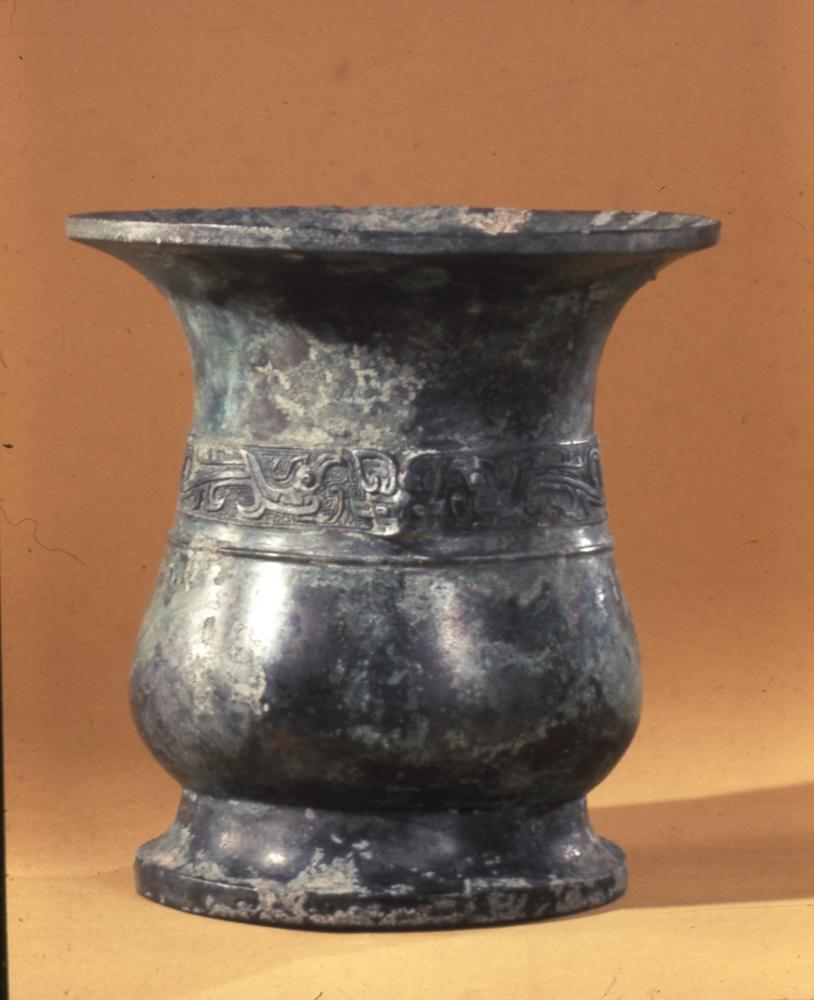
Porcelain altar vase with underglaze blue decoration and inscription. This heavily potted ‘min yao’ vase has a tall neck, dish mouth, long bar handles and a rounded belly, narrowing into a wide raised stand with a flat partially glazed base. It is painted underneath a green-blue glaze with prunus at the neck and a twenty-six-character inscription around the belly. Its form may be compared to contemporary Chinese seventeenth-century bronze altar vases.
IMG
![图片[1]-vase BM-1972-0128.1-China Archive](https://chinaarchive.net/Ming dynasty/Ceramics/mid_00263966_001.jpg)
![图片[2]-vase BM-1972-0128.1-China Archive](https://chinaarchive.net/Ming dynasty/Ceramics/mid_00355548_001.jpg)
Comments:Harrison-Hall 2001:Dedicated just six years before the collapse of the Ming dynasty and Manchu takeover, this archaistic vase was made at a time of tremendous social upheaval. According to its inscription it was commissioned by a woman, Mme Chen Niang, who presented it, as she was about to get married, to an unnamed temple as an act of benevolence, praying for all to have sufficient food and clothing. While monastic patronage was largely the domain of male members of a family, devotion to Buddhism was very common among the female gentry.
Materials:stoneware
Technique:glazed, underglazed,
Dimensions:Diameter: 12 centimetres Height: 24.70 centimetres
Description:
Porcelain altar vase with underglaze blue decoration and inscription. This heavily potted ‘min yao’ vase has a tall neck, dish mouth, long bar handles and a rounded belly, narrowing into a wide raised stand with a flat partially glazed base. It is painted underneath a green-blue glaze with prunus at the neck and a twenty-six-character inscription around the belly. Its form may be compared to contemporary Chinese seventeenth-century bronze altar vases.
IMG
Comments:Harrison-Hall 2001:Dedicated just six years before the collapse of the Ming dynasty and Manchu takeover, this archaistic vase was made at a time of tremendous social upheaval. According to its inscription it was commissioned by a woman, Mme Chen Niang, who presented it, as she was about to get married, to an unnamed temple as an act of benevolence, praying for all to have sufficient food and clothing. While monastic patronage was largely the domain of male members of a family, devotion to Buddhism was very common among the female gentry.
© Copyright
The copyright of the article belongs to the author, please keep the original link for reprinting.
THE END